
Opportunities
Rural Significance
Significant and unique challenges of rural health.
Unique challenges to rural health include limited access to diagnostics and treatments, uneven understanding of underlying causes and outcomes, and a sense of isolation in the absence of connection to healthcare, education, and research resources.
Significant opportunity to recruit and retain those who identify with the state of Montana.
Our recent recruitment process, resulted in more than 175 applications, with those who identify with the state of Montana greatly over-represented.
Significant combination of strengths and resources.
We bring to the table, the first center in Montana to combine the basic and translational research strength of the only independent biomedical research institute in the state, with training opportunities and research resources of the only nonprofit medical school in the state, and the clinical strength of the largest comprehensive health provider system in central Montana. This combination enables new opportunities as we move forward in terms of: Faculty recruitment, building of research infrastructure in a rural medical setting, training for physician scientists, internship and educational opportunities for faculty and students in adjacent regions, and for Montanans to access resources often confined to distant medical center strongholds.
Current Openings
-
Join Us in Montana!
The Weissman Hood Institute at Touro University
Senior Faculty Member
The Weissman Hood Institute at Touro University (WHIT) and the Touro College of Osteopathic Medicine – Montana invite applications for a faculty position at the associate or full professor level. We seek an individual who can take advantage of the unique environment and the recent establishment of an NIH Center of Excellence in biomedical and rural health research in Great Falls, MT. Areas of Institute strengths and strategy for future development include epidemiology, rural health, cancer, women’s health, behavioral health, neurology, psychiatric/psychology, or related areas. We have undergone a time of unprecedented expansion built on a foundation of translational research in neurological and neurodegenerative disease. Applicants with an active research program in basic, translational, clinical, and/or computational approaches to solving complex human health problems are encouraged to apply.
The Institute, formerly called the McLaughlin Research Institute, provides a novel environment for scientific studies and has been in operation for >70 years. The recent addition of the Touro College of Osteopathic Medicine, Montana campus, adjacent to the Institute provides for a vibrant environment of research, education and outreach. Opportunities for teaching and mentoring students are abundant. Candidates should possess a medical or doctoral degree, or equivalent, and have a record of research excellence.
Great Falls is a city of approximately 60,000, located on the Missouri River near Montana’s Rocky Mountain front, approximately 125 miles from Glacier National Park and 225 miles from Yellowstone National Park. The city provides a high quality of life with abundant outdoor opportunities. Faculty benefit from interactions with the Scientific Advisory Committee, the university system of Montana and the support of local organizations. For specific questions about the Institute or TouroCOM-MT, please visit our webpages at: www.weissmanhood.org or https://tourocom.touro.edu/about/location--contact/
This is a unique opportunity to take part in building the future of biomedical research in Montana and to bridge the urban and rural gap in biomedical research and healthcare systems. Applications will be reviewed on a rolling basis as they are received. For more information, please contact Dr. Renee Reijo Pera at reneer@mclaughlinresearch.org
Applications should include a curriculum vitae and description of research and be sent to:
Weissman Hood Institute at Touro University; 1520 23rd Street South; Great Falls, MT 59405
-
Inflammation in Aging and Neurodegeneration
The Hensley-McBain Lab is seeking a highly motivated Postdoctoral Research Fellow to join an interdisciplinary research program focused on inflammation as a key driver of aging and neurodegeneration.
Research focus. Research in the Hensley-McBain Lab integrates investigations of immune system function and genetics to understand how inflammation drives end-organ damage in age-related disease, with the goal of developing targeted approaches for prevention and treatment of age-related chronic disease. Current work focuses on inflammation in Alzheimer's disease, specifically ApoE regulation of immune responses in the gastrointestinal tract, periphery, and brain as a driver of inflammation and cognitive decline with aging. The successful candidate will lead projects examining how age, pathology, and genetics intersect to drive immune system dysfunction, inflammation, and disease outcomes. The lab employs hypothesis-driven approaches combining immunology, neuropathology, microbiome assessments, and genetics.
Career development. This position is structured to support the development of scientific independence, a strong publication record, and competitive extramural funding, with the goal of facilitating a transition to a faculty appointment at the Weissman Hood Institute. Projects will be tailored to the candidate's scientific interests to promote intellectual independence.
Required qualifications
• Ph.D., D.V.M., or M.D. in immunology, neuroscience, or a related biomedical field
• Demonstrated experience in immunology, molecular biology, and/or biochemistry
Preferred qualifications
• Experience with flow cytometry, cell culture, histology, and microscopy
• Prior work investigating mechanistic immune responses in in vivo systems and tissues
Expectations and opportunities
1. Lead independent, hypothesis-driven research projects
2. Develop and write manuscripts for peer-reviewed publication
3. Participate in grant writing and proposal development
4. Mentor trainees and contribute to shaping the scientific direction of the laboratory
To apply. Submit the following by email to thmcbain@mclaughlinresearch.org:
1. Curriculum vitae
2. A brief description of research interests and career goals
3. Letters of reference and contact information for 2–3 professional references
Learn more about the lab at weissmanhood.org/faculty-tiffany-hensleymcbain-phd.
-
Neuroimmune Mechanisms of Synaptic Dysfunction
The Cortese Lab at the Weissman Hood Institute at Touro University is seeking a talented Postdoctoral Research Fellow.
Research focus. Our lab investigates the neuroimmune mechanisms that drive synaptic dysfunction in psychiatric and neurodegenerative disorders. By integrating neuroscience and immunology, we study the complex interactions between the immune system and the central nervous system. We use genetic mouse models and cell culture systems to characterize disease-associated behavioral, neurobiological, and physiological phenotypes.
Required qualification
• PhD in neuroscience, immunology, or a related discipline
Preferred expertise. Applicants with experience in one or more of the following areas are encouraged to apply:
• Primary cell culture
• Immunohistochemistry and immunocytochemistry
• Imaging
• Western blot and ELISA assays
• Electrophysiology (whole-cell patch, slice physiology, multielectrode array)
• Data analysis
Qualities we value. Successful candidates will demonstrate strong communication and critical-thinking skills, a commitment to teamwork and collaboration, and the motivation to lead independent projects while contributing to laboratory operations. The Cortese Lab invests in the long-term success of its team by providing training, mentorship, and tools for professional growth and achievement.
To apply. Submit the following by email to giuseppe.cortese@mclaughlinresearch.org:
1. Curriculum vitae
2. A brief statement describing your research interests and career goals
3. Contact information for two to three references
Learn more about the lab at weissmanhood.org/faculty-giuseppe-cortese-phd.
-
No open positions.
To learn more about what we do, see here.
-
The Cortese Lab at the Weissman Hood Institute at Touro University is seeking a Research Technician.
Research focus. Our lab investigates the neuroimmune mechanisms that drive synaptic dysfunction in psychiatric and neurodegenerative disorders. By integrating neuroscience and immunology, we study the complex interactions between the immune system and the central nervous system. We use genetic mouse models and cell culture systems to characterize disease-associated behavioral, neurobiological, and physiological phenotypes.
Required qualification
• BA or BS in neuroscience, immunology, or a related discipline
Preferred expertise. Applicants with experience in one or more of the following areas are encouraged to apply:
• Primary cell culture
• Immunohistochemistry and immunocytochemistry
• Imaging
• Western blot and ELISA assays
• Electrophysiology (whole-cell patch, slice physiology, multielectrode array)
• Data analysis
Qualities we value. Successful candidates will demonstrate strong communication and critical-thinking skills, a commitment to teamwork and collaboration, and the motivation to contribute to laboratory operations while developing independent skills. The Cortese Lab invests in the long-term success of its team by providing training, mentorship, and tools for professional growth and achievement.
To apply. Submit the following by email to giuseppe.cortese@mclaughlinresearch.org:
1. Curriculum vitae or résumé
2. A brief statement describing your research interests and career goals
3. Contact information for two to three references
Learn more about the lab at weissmanhood.org/faculty-giuseppe-cortese-phd


Summer Internships for
High School & College Students
We are committed to serving as an educational resource for students and teachers in Montana. We offer summer internships for high school and college students, and also high school teachers as merited. Successful applicants will spend 8 weeks, from Monday, June 15, 2026 through Friday, August 7, 2026, in the laboratory of one of the Institute’s faculty or in the Animal Resource Center actively engaged in a current research project under the direction of the scientist, postdoctoral fellow, or research assistant.
In addition to providing hands-on experience in investigatory science, the students will observe and interact with other high school and college students in a laboratory-learning environment rather than a classroom. Journal clubs and seminars supplement the research experience. Each student will give a formal presentation at the end of the 8 weeks summarizing his/her project.
Requirements
Students who have completed their junior or senior year of high school or freshman through senior year of college are eligible. Students should be on track for four years of math, biology, chemistry and/or physics.
Due to liability reasons, we will only accept local high school students unless proof of supervised accommodations can be provided.
Successful applicants to the program must agree to fully commit 8 weeks of their summer to the internship.
Applications will open December 1, 2025 and close Jan 31, 2026. for preferred considerations. Additional applications will be taken after Jan 31 if slots are available. Please note applicants must be U.S. citizens.
Submit application materials here: Internship Materials

Application
Applications will open December 1, 2025 and close Jan 31, 2026 for preferred considation. Additional applications will be taken until March 10, 2026 if slots remain open. Final decisions will be made by late March; each applicant will be contacted via email regarding their application status. Thank you for your interest in the summer internship program! Please note that applicants must be U.S. citizens.
Internships begin Monday, June 16, 2025 and final presentations will be held Friday, August 8, 2025.
TO APPLY: Include a letter of application highlighting your interest in science, a resume, high school or college transcripts, and two letters of recommendation, preferably from instructors in the science/math disciplines. Recommendation letters should be sent from the recommender’s email address and written on the recommender’s institutional letterhead.
Please email all materials to admin@mclaughlinresearch.org or submit through the application portal: Intern application materials
Transcripts can be mailed to:
MRI Internship Program
1520 23rd Street South
Great Falls, MT 59405
Questions?
Email us at: admin@mclaughlinresearch.org
Summer research internships for talented high school students have been available since 1954, when Great Falls High School student, Irving Weissman, worked in the lab of the Institute’s founder, Dr. Ernst Eichwald. Dr. Weissman now chairs the Institute’s Scientific Advisory Committee, is a Professor at Stanford University and has co-founded several start-up companies.
Our internship program is made possible by the generous support of the community including: Gene Thayer, Randy Gray, David and Tanya Cameron, and Irv and Ann Weissman.
Program
Successful applicants will spend 8 weeks, from Monday, June 15 2026 through Friday, August 7, 2026, in the laboratory of one of the Institute’s faculty or in the Animal Resource Center actively engaged in a current research project under the direction of the scientist, postdoctoral fellow, or research assistant.
This is an in-person experience participating in cutting edge research at a center with world-renowned scientists and ties to prestigious research universities. Many of our interns have gone on to successful careers in research or medicine.
High School interns will receive a $3,500 stipend
College interns will receive a $4,600 stipend

Join our study!
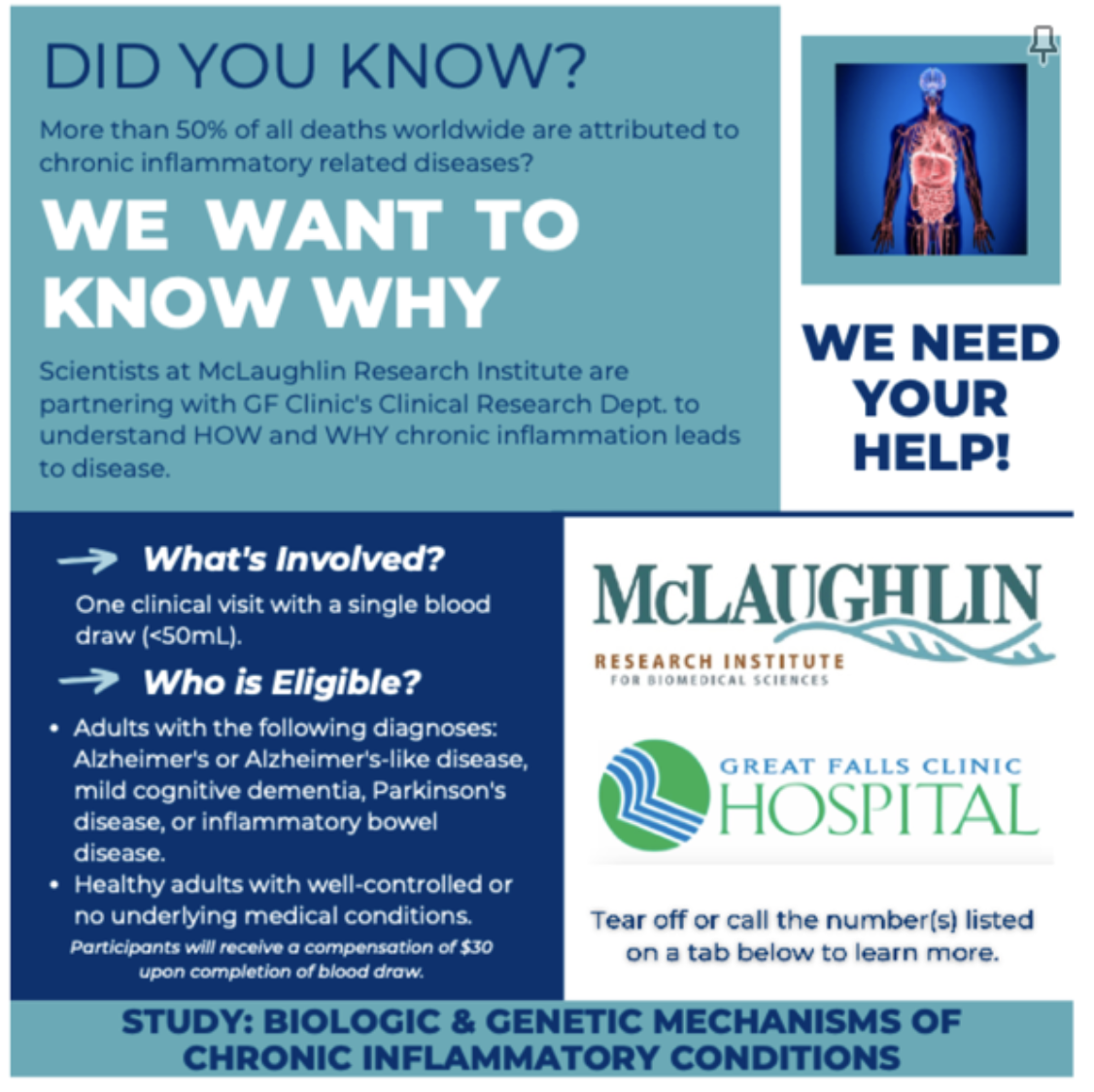
In collaboration with Great Falls Clinic, Dr. Tiffany Hensley-McBain has launched a study investigating genetic and biological mechanisms of chronic inflammatory conditions, in which participants come in for a single blood draw.
Call Rebecca Brown, Clinical Research Coordinator, at (406) 454-6045
Or click the link below to join the HERO Registry for participation in this or future clinical studies!
